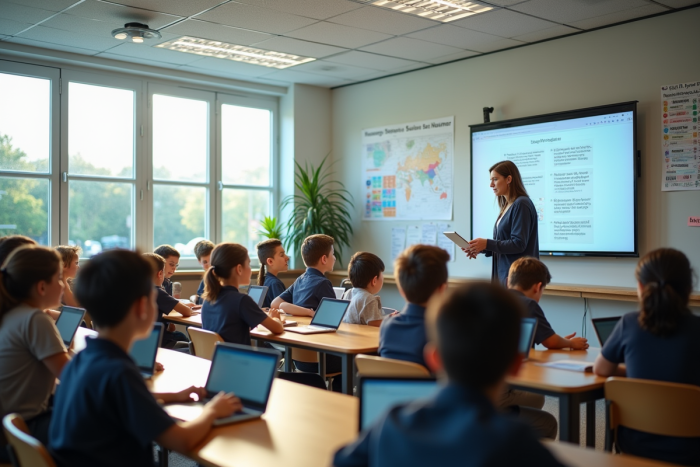
56%. This is the percentage of public middle schools that have at least one mobile tablet class in 2023. In elementary schools, this figure drops to 34%. On paper, modernity is everywhere, but reality is more complex. Some departments require each student to have an individual computer, while several teaching teams express their disagreement. Additionally, there is a clear divide: in rural areas, access to digital networks is still far from being standardized.
The allocated budgets do not always translate into effectiveness on the ground. Many teachers point out the lack of training and the absence of appropriate maintenance. From one institution to another, usage varies, just like the speed at which tools evolve. This diversity makes it difficult to generalize digital practices confidently.
Current Overview of Digital Equipment in Public Institutions: Figures, Disparities, and Challenges
The inventory of school digital equipment in public schools, middle schools, and high schools reveals significant diversity depending on the regions. The Ministry of National Education and local authorities are increasing purchases and initiatives, but on the ground, the situation resembles a patchwork. Some academies boast extensive coverage with recent equipment, tablets, and renewed computers in more than seven out of ten institutions. Elsewhere, the equipment remains outdated or underutilized, hindered by poor internet connectivity or the lack of technical support.
Here’s how these disparities in access and usage manifest concretely:
- In urban areas, most high schools benefit from high-speed networks and efficient digital tools, with shared workspaces.
- In many rural schools, teams adapt to outdated equipment or irregular network coverage, which significantly limits access to digital resources and ongoing teacher training.
Programs such as Digital Educational Territories aim to reduce these differences. Nevertheless, the integration of new tools is not always smooth. Platforms like ENT École 78, now almost indispensable for many families in Yvelines, detailed in the guide “Accessing ent.ecollege78.fr easily: ultimate guide for Yvelines residents”, illustrate both the advantages of digital technology and the limitations of a deployment that heavily depends on the local context.
Simply increasing purchases is not enough. For every student and teacher to truly benefit from digital technology, we must consider the adaptation, renewal, and maintenance of resources. Without this, even brand new equipment is likely to end up forgotten, stored in a cabinet, or reserved for occasional uses.

How to Thoughtfully Integrate Digital Technology to Support Learning?
In public institutions, teams are seeking to give educational digital technology a meaningful place in pedagogy. Installing computers or interactive boards is not enough: it is about transforming teaching, providing tools to diversify approaches, and supporting pedagogical differentiation. Feedback collected on the ground shows that when integrated thoughtfully, digital technology can enhance student engagement. However, each usage must correspond to the specific needs of the classes.
Digital resources continue to expand, but their effectiveness depends on teachers’ appropriation. This is where training plays a key role. Without regular support, these tools risk remaining peripheral. More and more middle schools and high schools are now offering modules to explore new practices: creating video clips, collaborative work on shared platforms, data analysis to personalize educational tracking.
Several action levers are emerging to strengthen the integration of digital technology in education:
- Enhancing digital skills: making students more autonomous in searching for and analyzing information.
- Offering tailored resources: providing a variety of relevant, regularly updated content.
- Gradually implementing a certification of digital skills throughout the educational journey, from primary school to high school.
One point remains on everyone’s lips: the impact of digital technology on learning. The continuity of education, tested during periods of health crises, demonstrated the usefulness of digital tools. However, their evaluation needs to be deepened: which uses are the most beneficial? How to avoid trends or the accumulation of underutilized equipment? For school digital technology to fulfill its promises, it will be necessary to combine quality equipment, solid training, and encouragement for pedagogical experimentation.
Between cutting-edge equipment and poorly connected classrooms, the digital school landscape is progressing, sometimes out of sync. But one thing is certain: the success of digital transformation is not measured by the number of tablets distributed, but by each student’s ability to seize tools to learn, understand, and grow in a world that is constantly reinventing itself.