Building a terrace in 2024 raises a specific tax question: what will be the actual impact on property tax, and should the work be declared to the tax authorities? The answer depends entirely on the type of terrace, its structure, and its relation to the ground. Two seemingly similar terraces can have radically different tax treatments.
Flat rate value and development tax: the hidden cost of a covered terrace
Most articles on the subject focus on property tax. They overlook another tax, one-time but sometimes substantial: the development tax.
A terrace that becomes a covered and enclosed space (closed bioclimatic pergola, conservatory, covered extension) creates a floor area in terms of urban planning. As soon as it exceeds 5 m² and 1.80 m in height, it triggers this tax. The calculation is based on a national flat rate value reassessed each year, multiplied by rates voted by the municipality and the department.
| Zone | Flat rate value 2024 (per m²) |
|---|---|
| Outside Île-de-France | 823 €/m² |
| Île-de-France | 914 €/m² |
This tax is due only once, at the time of construction. However, the covered and enclosed terrace also contributes to the calculation of the cadastral rental value, which permanently increases the property tax. The combination of the two taxes represents a budget item that many property owners discover afterward.
Understanding the rules of declaration and property tax for terraces before starting a project avoids this type of unpleasant surprise.
Taxable or non-taxable terrace: the criteria that shift the tax burden
The tax authorities do not reason in terms of material (wood, concrete, composite) but in terms of structure. The distinction is based on three characteristics: is the terrace elevated? Is it covered? Is it enclosed?
| Type of terrace | Impact on property tax | Development tax |
|---|---|---|
| Ground-level terrace, not covered, not enclosed | None | No |
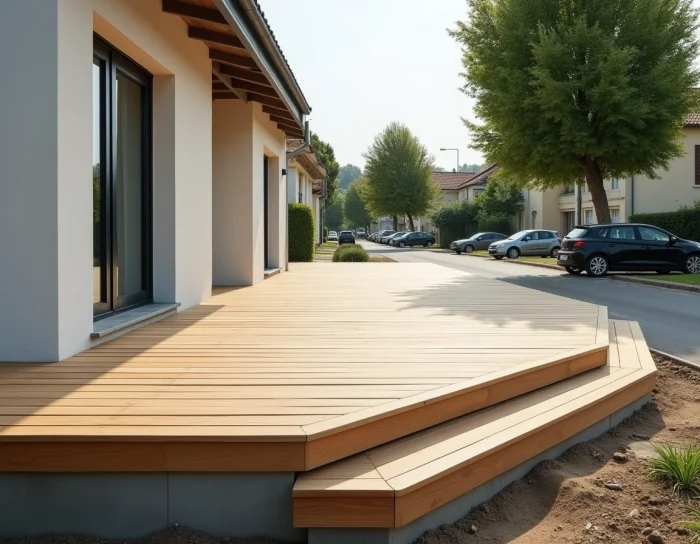
| Elevated terrace (on stilts, low walls) | Possible, depending on height and configuration | Possible if covered |
| Covered and enclosed terrace (conservatory, closed pergola) | Yes, included in rental value | Yes, if > 5 m² and > 1.80 m |
A terrace simply paved at ground level, without coverage or fencing, does not change the cadastral rental value. It therefore does not lead to any tax declaration or increase in property tax. This is the most common case for classic garden terraces.
On the other hand, as soon as a fixed covering element and a closing system transform the space into a living area, the tax shift is automatic. A pergola with adjustable slats but without fixed side walls generally remains in the non-taxable category. A bioclimatic pergola with sliding glass shifts to the taxable side.
Declaration of a new terrace to the tax authorities: the 90-day deadline
The construction of a terrace that modifies the property’s characteristics (addition of a closed and covered area, significant elevation) must be declared within 90 days following the completion of the work. This declaration is made online and allows the administration to update the cadastral rental value.
Failure to declare does not cancel the obligation. The tax services can recalculate the rental value during an audit or a cadastral update, with back payments for the undeclared years.
What must be declared
- Any new construction or extension creating a closed and covered area, even partial
- An elevated terrace that forms an identifiable room (such as a finished basement below, for example)
- The transformation of an open terrace into a conservatory or closed extension
What does not require a tax declaration
- A ground-level terrace, not covered, placed directly on the ground or on pedestals
- A simple replacement of the covering on an existing terrace (tiles, wood slats)
- The addition of an open pergola without fixed walls
The tax declaration is distinct from urban planning permission. Even if the town hall does not require a building permit (in the case of areas below a certain threshold), the obligation to declare to property taxes remains applicable as soon as the added area modifies the rental value.

Rumor of 2025 about terraces and balconies: what the administration says
At the beginning of 2025, viral information led to the belief that a new tax would target terraces and balconies. The General Directorate of Public Finances (DGFiP) issued a formal denial: no new tax on terraces has been created.
The rules for calculating property tax have not changed. The confusion arises from the fact that some terraces have already been included in the tax calculation for years, according to the criteria described above. The DGFiP reminded that the evaluation methods remain the same and that no legislative changes have occurred.
This clarification also highlighted a lesser-known reality: many property owners have never declared taxable improvements, such as conservatories or covered extensions. The administrative reminder has prompted some property tax offices to intensify checks for consistency between the cadastral data and aerial images.
Check if your current terrace is already taxed
Before starting work, it is useful to consult the descriptive sheet of your property on impots.gouv.fr. The personal owner space provides access to the elements used to evaluate the cadastral rental value: retained areas, nature of the premises, comfort elements taken into account.
The cadastral plan, available online, allows you to check if a terrace or extension appears in the property report. A discrepancy between the actual situation and the cadastral data indicates either a failure to declare or a correctable administrative error.
The determining criterion remains the same in all cases: a terrace that does not create a closed area, a covered area, or significant elevation has no tax impact. For any intermediate configuration, consulting the property tax office in your municipality remains the most reliable step before starting a project.