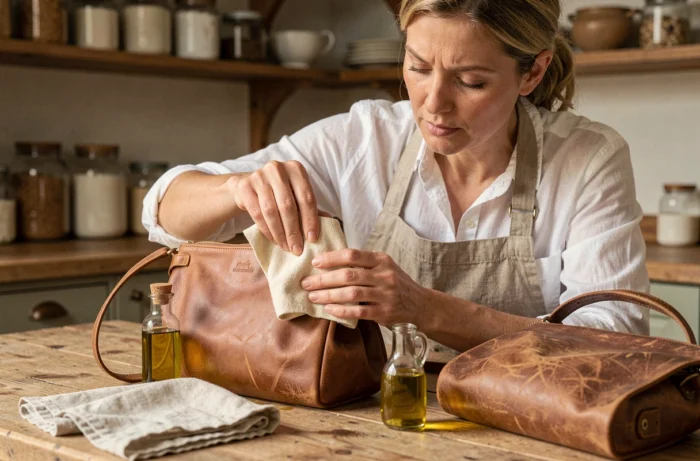
A leather bag forgotten in a closet for two seasons comes out stiff, dull, and sometimes cracked at the folds. Before looking for a specialized product, one can turn to olive oil, already present in the kitchen. Used correctly, it nourishes the leather fibers, restores their flexibility, and enhances their color. However, this action requires some precautions to avoid damaging the item you are trying to protect.
Aniline leather, pigmented leather, waxed leather: the reaction to olive oil varies by finish
Leather is often referred to as a unique material, while there are several finishes that absorb fats very differently. A smooth pigmented leather, like that of a city bag or a factory-dyed belt, has a protective layer on the surface. Olive oil penetrates little, remains as a greasy film, and can attract dust instead of nourishing the fibers.
In contrast, aniline leather (open pores, natural feel) quickly absorbs the fat. It is on this type of leather that olive oil truly nourishes the fibers deeply. It disappears within a few minutes, a sign that the leather has absorbed it.
Waxed leather, on the other hand, repels most oils by nature. Applying olive oil on waxed shoes is akin to applying a film that dulls the shine without adding anything. In summary, identifying the leather finish before any application avoids most unpleasant surprises. To delve deeper into leather care with Eklectik, useful guidelines on compatible leather types can be found.
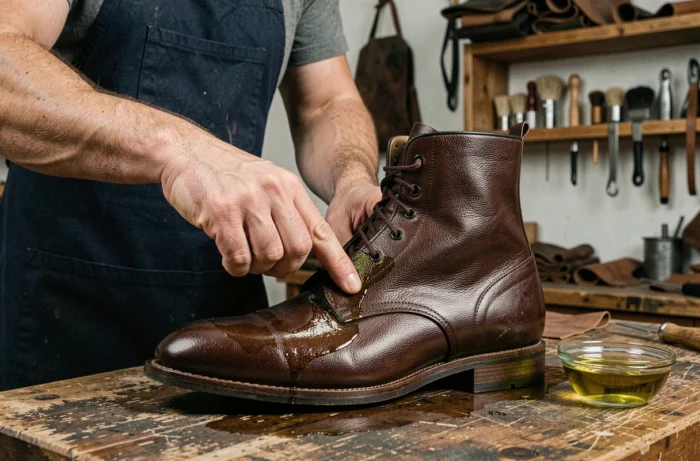
Applying olive oil on leather: step by step
The method is as important as the product. Poorly prepared leather or an excessive amount of oil can leave lasting stains, especially on light colors.
Prepare the surface before nourishing
Start by dusting the item with a dry, soft cloth. If the leather has ingrained dirt, a wipe with lukewarm water (a barely damp cloth, without detergent) is sufficient. It should then be allowed to dry completely before applying anything, as trapped moisture under a greasy layer promotes mold.
Measure and apply without excess
A few drops on a clean cotton cloth, not directly on the leather. Spread in regular circular motions, without focusing on one area. Two thin layers are better than one thick layer: excess oil does not penetrate, it stagnates on the surface and leaves a sticky feel.
- First, apply to a small discreet area (inside a flap, underneath a strap) to observe the color change before treating the entire item.
- Let it sit for about fifteen minutes, then wipe off the excess with a second clean cloth.
- Repeat the process if the leather still appears dry, waiting at least an hour between applications.
On light leather, olive oil often darkens the color irreversibly. The prior test in a hidden area is not an optional precaution; it is the only way to avoid a disappointing result.
Limitations of olive oil compared to specialized leather products
Olive oil is a quick fix. It softens dried leather and temporarily revives its appearance. It would be a mistake to consider it a permanent substitute for products formulated for leather.
A dedicated conditioner generally contains a calibrated blend of waxes and moisturizing agents that penetrate the fibers without leaving a greasy residue. Olive oil, on the other hand, is a food fat whose composition is not optimized for the collagen fibers of leather. In the long term, repeated applications can saturate the pores, softening the leather structure instead of merely making it supple.
On car seats, the issue is even clearer. Most automotive leathers have a protective finish. Olive oil remains on the surface, collects dust, and forms a film that gives a dirty rather than nourished appearance. For this type of leather, a product suitable for pigmented finishes yields better results.
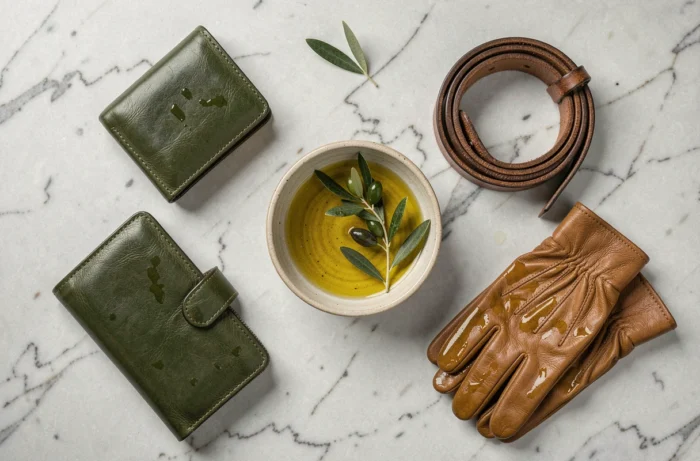
Which leather items to treat with olive oil and which to avoid
Not all items deserve the same treatment. Uses can be classified according to the level of risk.
- Full-grain leather bags, belts, and briefcases that are uncolored or dark: good candidates. The oil penetrates, softens, and the darkening of the color remains subtle on an already dark hue.
- Smooth waxed leather shoes: to be avoided. The wax forms a barrier, the oil muddles the finish without nourishing the material.
- Equestrian equipment (bridles, saddles): olive oil can soften very thick new leather, but specific greasing remains preferable to maintain the mechanical strength of tensioned parts.
- Sofas and car seats: to be avoided. The finish prevents absorption, and the risk of visible greasy marks is high.
Leather that absorbs oil within a few minutes is compatible. Leather on which the oil beads or stagnates after ten minutes is not. This simple test clarifies most hesitations.
Frequency and storage after application
Leather items should be nourished with olive oil once or twice a year, no more. Excessive frequency can soften the fibers and may generate a rancid smell if the oil has not been fully absorbed. After application, store the item in a ventilated area, away from direct light, until the leather completely absorbs the fat.
Olive oil remains a supplementary treatment for natural open-pore leather. On a valuable piece or leather whose finish is unknown, localized testing and occasional use protect better than regular treatment. The right reflex is to observe the leather’s reaction before generalizing the action to the entire surface.