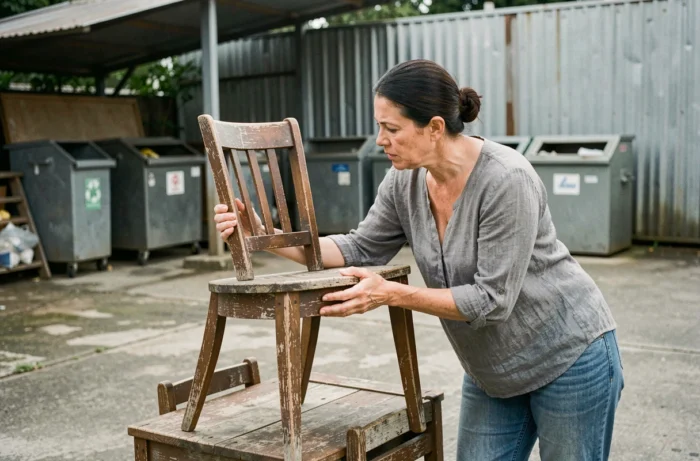
Used furniture falls under an extended producer responsibility (EPR) system structured around approved eco-organisms. Knowing where to drop off old furniture requires distinguishing between the different streams: reuse, material recycling, and energy recovery. Each channel follows specific criteria that determine the product’s fate.
Triman Marking and Source Separation: What the Regulations Require
Since December 15, 2022, furniture and bedding products must display the Triman signage indicating sorting instructions. Textile decorative items have been included since August 25, 2023. This marking directs towards two paths: donating when the product is still usable, or recycling it.
In practice, this obligation falls on market players, but it has a direct impact on individuals. A piece of furniture bearing the Triman logo should not end up in illegal dumping or in a mixed waste bin. We recommend checking this signage before choosing the drop-off channel: it specifies whether the product falls under Ecomaison (formerly Eco-mobilier) or Valdelia for professional furniture.
Understanding this distinction helps avoid saturating collection points with misdirected streams. A mattress, for example, follows a specific dismantling circuit (foam, springs, textiles) that is completely different from that of a particle board wardrobe.
Separating Reuse and Recycling: The Logic of Streams Ignored by General Public Guides
A piece of furniture in good condition and a piece that is no longer usable should not follow the same channel. The reuse chain described by Ecomaison includes several distinct steps: collection, storage, sorting, cleaning, repair, transformation, and then resale or donation. A product that is truly reusable must be able to pass through each of these steps without excessive cost.
Conversely, a structurally degraded piece of furniture (panel swollen by moisture, broken structure) clutters recycling centers and generates unnecessary storage costs. Dropping it off at a waste disposal site in the “furniture” bin remains the best option: the wood, metals, and foams will be separated for material recycling or energy recovery.
If you are specifically looking for where to drop off old furniture, the first reflex is to assess the actual condition of the product before choosing between donation and disposal at a waste facility.
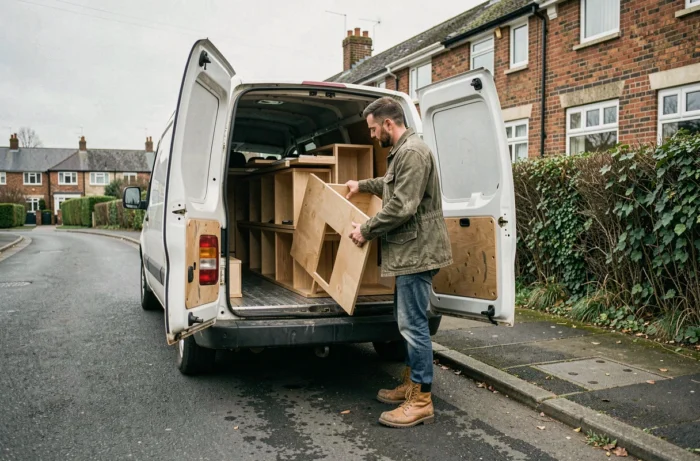
Furniture Collection Points: Waste Disposal Sites, Recycling Centers, and Home Pickup
Municipal waste disposal sites remain the main drop-off point for used furniture. Almost all local authorities have a bin dedicated to furniture, separate from the raw wood bin. This upstream sorting facilitates the work of collection centers managed by eco-organisms.
Recycling Centers and Social and Solidarity Economy Associations
Recycling centers apply a qualitative sorting at entry. They refuse items that are too degraded, ensuring a high reuse rate. Before you go, check the acceptance criteria specific to each structure.
- Solid wood furniture with a sound structure: prioritized, as they can be easily restored by sanding and finishing
- Sofas and armchairs without stains or major tears: accepted provided they comply with current fire safety standards
- Bedding less than ten years old without visible sagging: some structures accept it, while others systematically refuse it for health reasons
- Flat-pack furniture with complete hardware: can only be valued if the assembly parts are present
Home Pickup by Eco-Organisms
Ecomaison offers home pickup solutions in certain areas, in partnership with local authorities. This service particularly targets bulky items (wardrobes, bed bases) that are difficult for individuals to transport. Time slots can be booked online through local bulky waste management platforms.
Recycling Wood Furniture and Panels: What Happens to Collected Furniture
Solid wood recovered at waste disposal sites is shredded and then directed towards the production of recycled particle boards. Particle boards containing formaldehyde resins undergo a distinct treatment, as their direct combustion would produce toxic emissions. Sorting by wood type, carried out at collection centers, determines the quality of the recycled material.
Mattress and seating foams are mechanically separated. Polyurethane foams can be transformed into insulation underlays or industrial padding. Metal springs go to the conventional scrap metal stream.

Recent experiments are testing reuse in places that are not waste disposal sites. During the Vieilles Charrues 2026, Ecomaison organized the collection of still usable camping equipment to redirect it to a solidarity-priced recycling center. This type of initiative shows that the collection of used furniture is gradually moving beyond the strict framework of waste disposal sites.
Common Mistakes When Dropping Off Used Furniture
We regularly observe practices that slow down the system or generate refusals of acceptance.
- Mixing furniture and green waste in the same trailer: waste disposal agents then have to separate them manually, which prolongs processing times
- Dismantling a piece of furniture without keeping the hardware: an incomplete flat-pack piece loses all possibility of reuse and automatically shifts to recycling
- Dropping off a mattress wrapped in plastic: over-wrapping complicates sorting and must be removed before drop-off
On the regulatory side, illegal dumping of furniture on public roads can result in fines. Local authorities are increasing enforcement, and surveillance cameras now allow for the identification of offenders at many sensitive sites.
Upstream sorting at home remains the most effective action to direct each piece of furniture to the right channel. Assessing structural condition, removing non-wood elements (mirrors, glass, metal handles), and separating bedding from wooden furniture: these simple actions speed up processing at collection centers and improve the actual recycling rate of collected furniture.