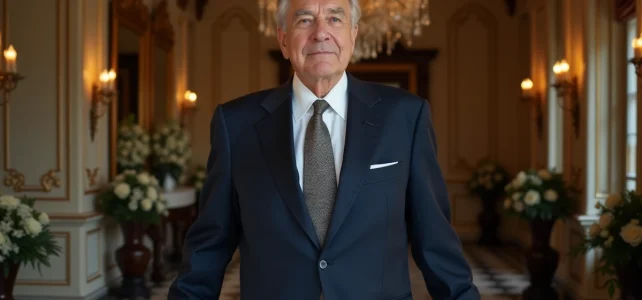
While elsewhere hotels change hands through takeovers and reorganizations, the Ritz Paris continues to cultivate a singularity jealously preserved. When Mohamed Al-Fayed took the reins in 1979, the palace did not rely on groups. It freed itself from the codes of the CAC 40, escaping impersonal logics. The result: the Ritz endures through trends and decades, weathering media storms or waves of renewal, without yielding any of its almost impenetrable aura. Here, stories of passion, instinct, and of course, family are written.
It all begins at the dawn of the 20th century, with César Ritz. The son of a modest Swiss farmer, he imposes an unprecedented vision: the hotel for the pleasure of the senses, a theater of social life, a place where everyone comes to be seen, to mingle with the elite, to inscribe themselves in a story that transcends them. In Paris as elsewhere, the Ritz quickly establishes itself as a haunt for artists and crowned heads, a refuge for both extroverted souls and discreet billionaires.
After César Ritz’s death in 1918, his wife Marie-Louise dedicates herself wholeheartedly to the longevity of the myth. With loyal staff and entourages, she preserves the charm and maintains the standards. The corridors tell a thousand anecdotes, each salon has been the theater of alliances, confessions, and rivalries. Here, a writer captures the essence of an era (the ghosts of Proust are still present), there, a conversation sketches out the Paris of tomorrow. More than a hotel, the Ritz becomes the muted mirror of a society in perpetual motion.
For Place Vendôme is not simply the backdrop for luxury tourism. It is the vibrant stage of ambitions and strategies, from glorious pasts to contemporary evolutions. Between memory books and research on who owns the Ritz Paris, the curious always return to the same enigma: how has this palace managed to endure through so many eras without losing its magic? The demand for excellence here is not the result of a marketing argument, but the consequence of a way of thinking.
César Ritz, the pioneer who shook up classic hospitality
The Ritz Paris is tied to the vision of this singular man. Starting from very humble beginnings, César Ritz foresaw that the future of luxury hospitality lay in innovation, attention to detail, and the ability to create an atmosphere. In Paris, he quickly imposes his mark: each service becomes an experience. One does not simply come to the Ritz for a room; one enters to be seen, to write their own interlude in the frenzy of the Paris elite.
After the César era, Marie-Louise Ritz carefully oversees the maintenance of the hotel’s reputation and spirit. Under her watch, the Ritz does not succumb to snobbery or nostalgia. The hotel gradually establishes itself as a pillar of the Parisian landscape, a rallying point for both aristocrats and artists. Proust’s works immortalize the palace, transforming its salons into places of collective memory where excellence is never a nuance, but a guiding principle.
From all sides, it quickly becomes clear that the Ritz Paris does not cater only to the powerful. It also attracts those who wish to partake in a legend in the making: builders, renovators, creators, all driven by the desire to transmit an identity, at any cost. The imprint of César Ritz, palpable, continues to inspire well beyond the borders of Place Vendôme.
Who owns the Ritz Paris today? Between discretion and legacy
The face of the owner is never prominently displayed in the media. Discretion matters, almost as much as the quality of the welcome. After the Ritz family, the palace experiences several transitions, marked by acquisitions, transmissions, and closed-door strategies. Each generation brings its nuances, but the house does not change its soul.
The ownership of the Ritz has thus become diluted: succession, cleverly orchestrated legal structures, shares held according to circumstances… This choice of anonymity preserves the exceptional character of the place, away from strictly financial reasoning. Here, anonymity does not serve to hide a weakness, but to protect the uniqueness of the palace.
At the helm of the house, leaders like Olivier Dabescat embody this subtle balancing act. They transmit, innovate, and retain teams capable of responding internationally while respecting Parisian customs. The Ritz maintains its mystery: questions abound, answers elude, but all of this weaves the legend. One does not enter this circle without understanding that mystery holds a place just as important as the porcelain on the table.
The Ritz Paris, a pioneer of modern luxury: innovations and legacy
From its inception, the Ritz has focused on unprecedented advancements. At the end of the 19th century, private bathrooms equipped each room, a luxury unimaginable elsewhere. Later, direct telephone lines, innovations in the kitchen, everything is designed to surprise and exceed expectations. Paris then discovers a hospitality approach where nothing is left to chance.
The Ritz has not usurped its literary myth either. Proust, true to his habits, observes, draws inspiration, blending Parisian reality and fiction in his writings. Today, the tradition of personalized service continues: teams are trained to combine discretion with tailored attention. Under the leadership of personalities like Olivier Dabescat, excellence becomes a given, and the address has lost none of its power to fascinate.
History, crises, and decades have never erased the spirit of the Ritz. The hotel takes on, in turn, the role of refuge, salon, and headquarters. It inspires artists, consolidates a typically Parisian art of hospitality, and adapts without ever renouncing itself.
This is why the Ritz Paris retains this unique reputation, renewed from generation to generation:
- Hotel innovation: from the beginning, private bathrooms, technical equipment, pioneering cuisine.
- Literary strength: presence of great authors like Proust, anchoring of the “proust ritz” in French culture.
- Heritage dimension: worldwide recognition of the palace, beyond borders and trends.
Crossing the doors of the Ritz Paris today means rediscovering the rare alliance of luxury, mystery, and a form of eternity. In Place Vendôme, the legend is not told; it is experienced, between embraced splendor and whispered confidences away from the tumult.