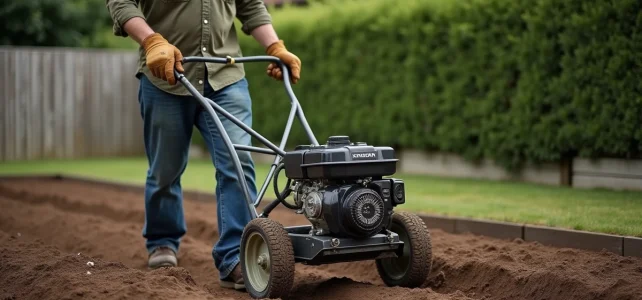
A thermal lawn seeder is a self-propelled machine that sows, buries, and compacts grass seeds in a single pass. It differs from a simple spreader by its rotor, which drives the seeds into the soil at a consistent depth, and by its integrated roller, which ensures the necessary seed-to-soil contact for germination. This tool is designed for medium to large areas, where broadcasting shows its limitations in terms of uniformity.
Dosage and adjustment of the hopper before the first pass
Most articles on the subject detail soil preparation but overlook a crucial point: the adjustment of the hopper flow determines the density of the grass. Each seed mixture has a reference weight per square meter, indicated on the packaging. A slight deviation produces either sparse areas or overly dense grass that suffocates as it grows.
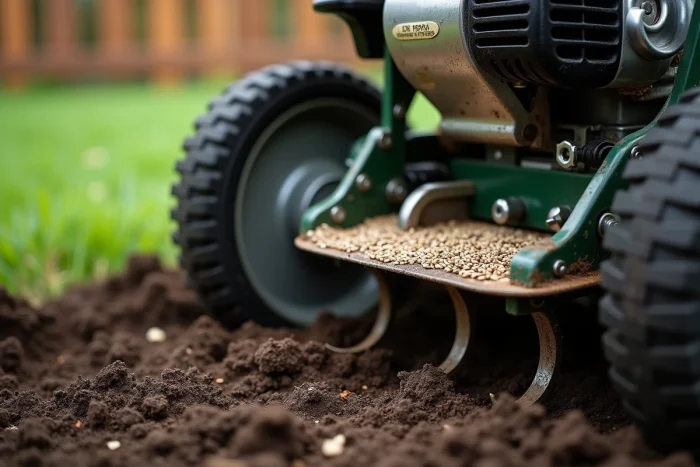
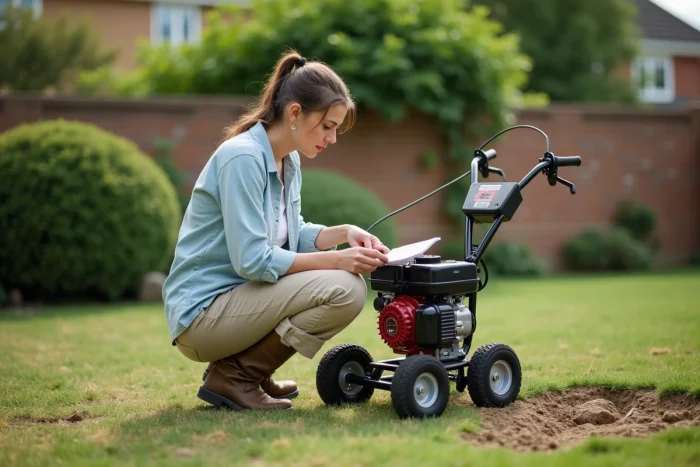
On a thermal lawn seeder, the flow is adjusted via a knob or a graduated lever located above the hopper. Before starting the job, pour a measured amount of seeds and make a test pass over a strip of a few meters. Weigh what remains in the hopper to check that the dose corresponds to the recommended weight.
The choice of a thermal lawn seeder for sowing grass makes perfect sense in this regard, as the mechanical consistency of the flow avoids the overdoses or shortages typical of manual sowing.
If you are using a drought-resistant mixture (tall fescue, next-generation ryegrass), ensure that the seed size is compatible with the hopper opening. Some coated seeds have a larger size that can block the mechanism if the opening is too narrow.
Ground pass technique: speed, overlap, and direction
The thermal lawn seeder is self-propelled, which means that the forward speed directly influences the density of the sowing. Walking too fast reduces the amount of seeds deposited per square meter. Too slowly, the rotor drives the seeds deeper than necessary.
The ideal pace is a steady walk, without acceleration or sudden stops. The rotor spins at a constant rate as long as the engine is running at full throttle, but it is your movement that determines the final distribution.
Managing overlap between strips
The working width of a lawn seeder is generally around 70 cm. To avoid unsown strips between two passes, plan for an overlap of a few centimeters. Align the edge of the roller with the trace left by the previous pass.
- Work in parallel strips along the entire length of the area, then return in the opposite direction for the next strip.
- At the ends, raise the hopper or cut the flow before turning to avoid a pile of seeds in the corners.
- On sloped terrain, progress in the direction perpendicular to the slope to limit seed runoff during the first watering.
If the terrain has irregular areas (depressions, residual bumps), a crossed pass at 90 degrees improves coverage. Then reduce the flow by half on each pass to maintain the correct total weight.
Soil preparation: what the rotor does not correct
The mesh roller at the front of the machine breaks up surface clods, but it does not replace proper foundational work. Compacted soil, filled with stones or poorly leveled, will compromise germination, regardless of the quality of the mechanical sowing.
The soil must be loose to at least ten centimeters deep. A pass with a tiller or rotavator, followed by raking, is the minimum. Remove surface stones and fill depressions with a soil-sand mix.
Fertilizer application and amendment
The lawn seeder only distributes seeds. Starter fertilizer (rich in phosphorus to promote rooting) should be spread separately, before the machine passes. Incorporate it into the soil during the final raking.
If your soil is clayey and heavy, a sandy amendment on the surface facilitates root penetration. On very acidic soil, liming a few weeks before sowing balances the pH and promotes germination.
Watering and post-sowing follow-up: the critical phase
The work of the lawn seeder stops at compaction. The rest depends entirely on water. The seeds must remain moist at all times until germination, which generally takes one to three weeks depending on the temperature and the chosen mixture.
Water with a fine spray, several times a day if necessary, to keep the top few centimeters of soil moist without creating runoff. Too powerful watering displaces the seeds and creates bare spots.
Sowing period and climatic constraints
Spring and early autumn remain the two optimal windows. The soil temperature must be high enough to trigger germination, and the risk of frost must be avoided. In autumn, natural rains reduce the need for manual watering, which is a significant advantage in regions subject to summer water restrictions.
Recent mixtures include varieties more resistant to drought (tall fescues, next-generation ryegrass). Choosing a mixture suitable for water stress reduces dependence on watering in the long term, a criterion increasingly relevant in the face of prolonged heat episodes.
The first mowing occurs when the grass reaches a sufficient height, without cutting more than one-third of the total height. Before this stage, avoid walking on the seeded areas to not disturb rooting. A well-conducted mechanized sowing, on properly prepared soil and regularly watered, produces a dense and uniform lawn from the first season.